


For a quick overview see the Rules Summary.
The game Baladana™ (a.k.a. Baladãna™) is played
by two players on an eight-by-eight squared game board (the same as a
chess board).
Each player has 16 playing pieces or figures; one set is white, the other
is black. There are also 20 colored rings. A ring can be placed either
directly on the game board (these are called 'free rings'), or it may
be placed on a figure. All rings except for the golden ones start as free
rings and do not belong to any player until they are picked up and placed
on one of the adjacent figures during the game.
Once a ring is placed on a figure, it belongs to the player who owns that
figure and can be moved only by that player (see section Ring
Move below).
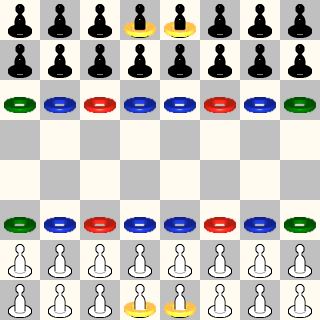
At the beginning of each game, the figures and rings are arranged as illustrated.
Starting in the initial configuration shown, players take turns making a move; white figures go first.
The objective of the game is to capture both of your opponent's golden rings.
Each move has two parts:
The Ring Move must come before the figure move, however it is optional
and you may skip it if desired (except in a draw situation - see section
Draw below).
The Ring Move can be one of two types. You can either:
a) Pick up the top ring from one of your figures and place it on any other figure or square anywhere on the game board, or
b) Pick up a free ring (one that is not placed on a figure) and place it on one of the adjacent figures (each square has 8 adjacent squares). However, to be able to pick it up the ring must be surrounded by more of your own figures than your opponent's (counting all figures on the 8 adjacent squares).
When a ring is surrounded by the same number of white and black figures, then neither of the players can pick it up.
The maximum number of rings that can be placed on any figure is 3.
When placing a ring directly on a square, two or three may be stacked
up on the same square as well.
Move one of your figures according to its powers (it may or may not be one of the figures involved in the ring move). A figure may not jump over other figures or free rings (with the exception of a figure with only a blue ring - see Rings and Powers), and it cannot land on a square occupied by a free ring or a figure of the same color.
You can capture an opponent's figure (provided that both of your golden rings are placed on the same figure - see section Golden Rings) by moving to a square it occupies. The captured figure is removed from the game. If the figure has any rings, one of them must also be removed from the game (the 'tax'), but the rest of the rings (if any) may be kept as 'loot'. The player making the move can select the ring(s) he or she wants to keep and place them on any figure(s) or square(s) on the game board.
Figures with no rings cannot move. The red, green and blue rings represent different powers (the golden rings are special - see the next section). When a ring is placed on a figure it gives it a certain 'power' to move according to the ring's color. When two or three rings of different colors are placed on a figure the powers combine.
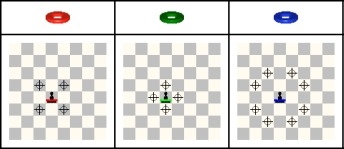
A red ring allows a figure to move diagonally one square at a time.
A green ring allows a figure to move vertically or horizontally one square at a time.
A figure with only a blue ring can move in an L-shaped path - the same as a knight in chess. This is the only type of power that allows a figure to jump over other pieces.
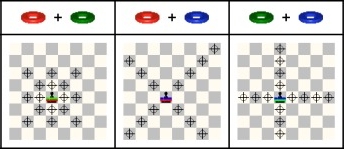
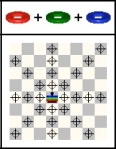
When combined with a red and/or green ring, the blue ring adds the power to move any number of squares in their particular direction.
The order in which rings are placed on a figure does not matter.
Placing a second ring of the same color on a figure (for example adding
a second blue ring) is possible, however it does not affect the combined
power.
The powers can be thought of as having two components: distance and direction.
In this sense the red rings provide the diagonal direction (but they lack the distance so a figure with only a red ring can move diagonally, but only one square).
The green rings allow the horizontal and vertical direction (again, without other colors only one square at a time).
The blue rings provide the distance, so combined with the green and/or red rings they allow moving a figure in the particular direction as far as the edge of the board. By itself, however, the blue ring lacks a direction, so a figure with only a blue ring can move only to squares that surround it in sort of a 'circle'.
The three elementary powers and all the possible combined powers are illustrated in the table below.

The golden rings are special. They do not affect the power of the particular figure they are placed on (a figure with just a golden ring on it cannot move at all). However, they are extremely important to the team!
A player must have at least one golden ring on one of his or her figures to be able to continue to play. To be able to capture opponent's figures, the player must have both golden rings and they must be placed on the same figure! When a player loses one of the golden rings, all he or she can hope for is a draw (since the player cannot capture figures anymore, a victory is no longer possible).
A player may place one of the golden rings on a square during the game, perhaps as a last-resort defensive maneuver. However, such a move implies that he or she will not be able to capture figures until both of the golden rings are placed on one figure again (if it becomes possible to pick up the golden ring again in a later move).
The two golden rings together represent the power of the king.
When the power is concentrated in one figure, the leadership is strong, allowing the player to capture opponent's figures.
When both golden rings are lost, so is the kingdom - and the game.
When a player still has at least one golden ring, but he or she cannot make any move, then the game ends in a draw - no one wins. However, the phrase 'cannot make any move' includes the Ring Move. This means that if there was a Ring Move possible such that the player could move one of his or her figures after that Ring Move, then the player must make this Ring Move or will lose the game.
Also, a player cannot 'give up' the last power ring by placing it on a square or on an opponent's figure and claim a draw. In this case, the inability to move is clearly his or her own fault and the player loses the game.
In other words, when a player claims a draw because he or she cannot move, if the opponent can show a ring move that was possible which would have allowed the player to move, then it is not a draw but the player loses the game.
Copyright © 2005 Citta Consulting Inc. All Rights Reserved.